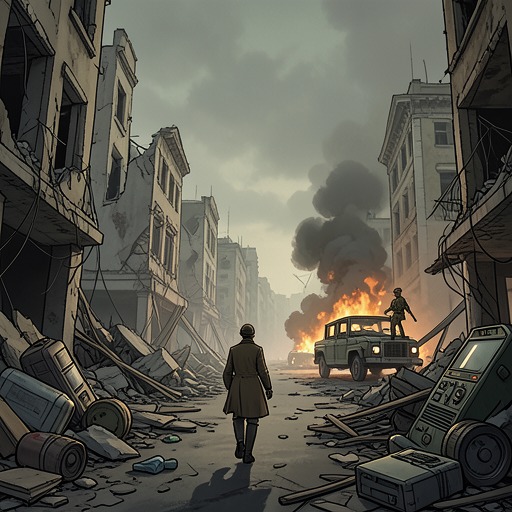
Post-apocalyptic societal collapse
The Dog StarsPost-apocalyptic societal collapse is not a single disaster but the long aftermath of successive epidemics and the disintegration of ordinary systems of care, communication, transport, and security. Nine years after the flu killed almost everybody, a further blood disease has taken more lives; survivors maintain small, exposed communities amid abandoned infrastructure and persistent danger. The world’s remnants are uneven: aircraft and satellites still function, while roads, runways, hospitals, and cities bear the consequences of neglect, violence, and mass death.
Disease and uncertain origins
The collapse begins with a flu pandemic, followed by a blood disease that further reduces the surviving population. Hig describes the flu as having killed almost everybody and the later disease as having killed more. His account places the story nine years into this aftermath, long enough for survival to become routine but not long enough for the scale of loss to become remote.
The disease’s origin remains unresolved. In a conversation with Cima, Hig asks whether it began in New Delhi, reflecting what the press had reported. Cima recounts a rumor that the outbreak involved a monitored superbug combined with bird flu, and that the first cases in London were blamed on New Delhi. Another rumor points instead to Livermore: a sample carried on a military flight was supposedly being transported to England when the plane crashed in Brampton. The account offers no confirmation of either origin. Its uncertainty is part of the disaster’s legacy: even survivors discussing the catastrophe cannot reliably reconstruct how it began.
The later illness is also described through incomplete medical knowledge. Cima identifies herself as an internist specializing in public health and discusses a proposed connection between autoimmune disease and the body’s reduced ability to make vitamin D, comparing its mechanism to AIDS and T cells. The explanation is tentative, not a settled account of the disease. Alongside the scale of mortality, the evidence preserves how little is known about the condition that followed the flu.
The failure of ordinary care and communication
St. Vincent’s Hospital, across the lake, became one of the places where people sought help as the crisis worsened. Its buildings were taken over and filled with the dead. The hospital’s fate marks a change in what medical infrastructure could offer: a familiar institution remained physically present, but no longer represented dependable care or recovery.
The public account of the pandemic also breaks down over time. Cima remembers television news becoming increasingly exhausted and frightened as broadcasters and field correspondents disappeared into hospitals and makeshift flu wards, or stopped reporting altogether. The final broadcasts grew more frantic before being cut short by mayhem. The sequence shows communication failing alongside medical response: people could still receive reports for a time, but the networks carrying those reports could not continue to function normally.
Not every technical system disappears. Hig’s Garmin GPS still receives satellite signals and can warn him when his aircraft approaches high ground. That survival contrasts with the deterioration of the ground below: many runways have become unusable, and others require precise knowledge of potholes to navigate safely. The contrast is practical as well as symbolic. A functioning navigation device cannot restore the infrastructure it once helped people use.
Isolated settlements, danger, and cooperation
The old airport where Hig and Bangley live offers some material advantages: it was built near a creek, has open ground around it, and once used solar panels and wind power. Hig describes four 60-watt panels on the house, sufficient for a single LED light through the night. Those resources make the site habitable, but also attract intruders. Survivors come singly or in groups, armed with hunting rifles or knives, approaching the lit porch after dark. Hig sleeps outside, behind a berm a hundred yards from the house, so he cannot be trapped inside it; Jasper’s warning growl alerts him to an attack.
The violence changes in frequency without wholly ending. After the second summer, visits taper off until there is perhaps one visitor in a season, followed by nearly a year without one. Then four desperadoes arrive, nearly overwhelming the defenders; after that, Hig begins flying regularly. The lull does not mean the danger has passed. It changes the rhythm of vigilance, leaving the possibility of renewed attack embedded in ordinary life.
A Mennonite community of roughly thirty people lives ten miles south. Its members suffer from the blood disease, which also affects their children, who are born sick and weak; some die each year. Hig and Bangley call them families and do not treat them as a direct threat. Their situation demonstrates how vulnerability persists in small settlements even where immediate violence is absent: proximity, shared territory, and need do not eliminate the consequences of disease.
Survival can also depend on difficult choices about whom to trust. Hig and Bangley protect their airport together, but their principles differ: Bangley favors shooting first, while Hig resists treating every visitor as guilty. In Hig’s view, a visitor can be allowed time to show whether they are human; Bangley’s rule is that negotiation risks death. Their partnership thus provides a measure of security without resolving the moral conflict produced by the collapse of public authority.
Ruined cities and contested routes
Grand Junction makes the scale of destruction visible beyond the isolated airport. From the air, Hig sees a city marked by fire: cars are scorched, entire neighborhoods have burned, and human bones lie in heaps or scattered across the ruins. Cottonwoods along the river parks still provide patches of shade, although some are only half alive and clothed in leaves on one side. The surviving greenery does not undo the destruction; it appears amid a landscape where fire has reached every part of the city.
The devastation is personal for Cima, who recognizes the city as a place where her family once shopped for supplies and went to the movies. She and Pops left their ranch as the crisis worsened, before the broadcasts ended. Their departure required a hazardous journey: they took livestock, horses, dogs, and provisions, crossed three barricaded ambushes in fifteen miles, and encountered further armed attackers in the cedar hills. They lost animals along the way, then entered the canyon with their remaining supplies. The next morning, Pops used dynamite to make the ford impassable except on foot or horseback, and only at low water. The journey shows how migration became both an escape from danger and a defense against pursuit.
The wider transport network has likewise become unreliable. Hig recalls that the runways have returned toward grass and ground with startling speed, while exposed steel corrodes and roots break structures apart. A once-useful aircraft handbook still supplies takeoff tables, but the airfield conditions for which pilots might consult them have changed. The degradation is cumulative: neglected surfaces and structures can become unusable within the nine years separating the old world from the present one.
A changed social and ecological order
The collapse does not leave a simple contest for scarce food. Hig reflects that he and Bangley have enough food, raw materials, and quilts, yet their shared resource base can still feel cramped because their disagreement is ideological. He connects their division to earlier conflicts among the Ute, Arapaho, Cheyenne, Comanche, Sioux, Kiowa, and Apache, whose histories he read as a boy. The comparison turns on the question of why people divide territory in a landscape that seems vast: in the present, he suggests, conflict survives not only from material shortage but from the ideas people attach to security and authority.
Some adaptations are quieter than armed defense. Bangley, who once said that the only dirt he would dig would be for a grave, learns from Hig how to water a garden, direct water from a header into the furrows, and distinguish weeds from crops. His father had been a farmer. The episode places practical knowledge and inherited memory beside the weapons and perimeter that first organize their survival: maintaining life requires labor that their defensive system alone cannot supply.
The sky offers a further sign that the world has not become wholly silent. Two 747s pass over Erie, and Hig hears an Arabic conversation and laughter on the radio as the aircraft head west at thirty thousand feet. He calls repeatedly, identifying the airport, but cannot establish contact. Similar aircraft appear at roughly weekly intervals; on the fourth week none arrive, and four people gather on the porch to wait. The brief recurrence of distant flights suggests that activity continues elsewhere, but provides no assurance of rescue, connection, or a restored society. In this world, a functioning satellite, a working radio, or a plane overhead can survive the institutions that once made those technologies part of a dependable network.